|

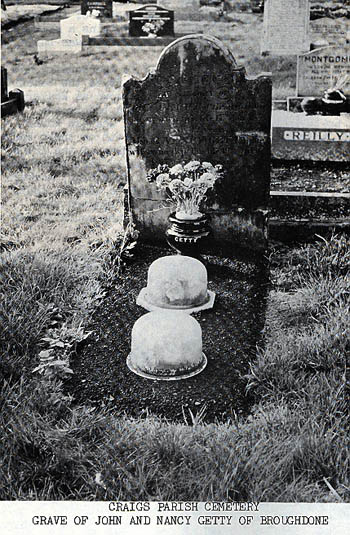 "Erected in Memory of John
Getty of Broughdone who departed this life 17th
Jan 1851, aged 92 years, also Nancy Getty his
wife who departed this life 19th July 1867, aged
103 years" "Erected in Memory of John
Getty of Broughdone who departed this life 17th
Jan 1851, aged 92 years, also Nancy Getty his
wife who departed this life 19th July 1867, aged
103 years"
On the following page are a
few paragraphs taken from an article titled
"Ahoghill! It Has A Rich History", which
appeared in the Ballymena Observer, Thursday,
February 21, 1980.
"This community is a
friendly one indeed. The folk are ever ready to
bid you 'time of day', or have a 'bit of a
crack' with you if the opportunity arises.
They'll do you a good turn if they can and
there's no denying their hospitable spirits.
Ahoghill is a very ancient village, mentioned by
a French traveler as far back as the 12th
century who at that time described it as
comprising a few small dwellings. The story has
it that he did not stop there, as he found no
convenient place to water his horses, which
seems strange as the name of Ahoghill means 'the
meeting place by the bushes by the ford.'
"An ancient O'Neal Castle
once stood on the route on an old highway on
what is now the Straid road and there was a John
O’Neal who was rector of Ahoghill between
1376 and 1471. The ancient graveyard at Church Street
contains a gravestone of singular interest, with
the inscription: 'The vault underneath was built
before the country was enriched by the linen
trade.'
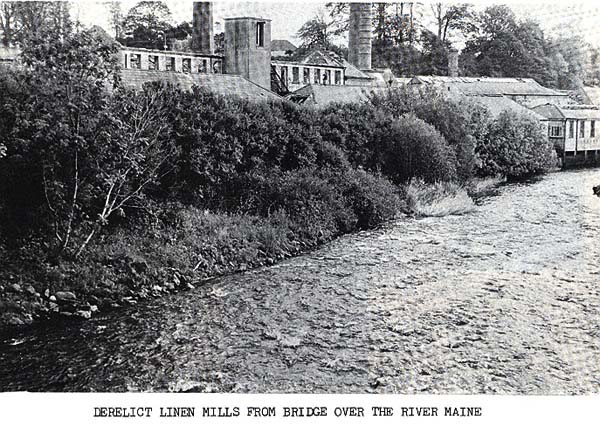
"The linen trade brought a
great measure of prosperity to the country and
Ahoghill, like many another community in
Northern Ireland, enjoyed the benefits. The
noise of the handlooms could once be heard at
what was known as Weavers' Row, on the Ballymena
Road at the approach to the village, and before
the Braidwater Spinning Mill was built in
Ballymena, the Ahoghill weavers would leave
their homes in the small hours with their
bundles of cloth on their backs, and set off on
foot for the markets in Belfast. With the coming
of the industrial revolution, the young men and
women of Ahoghill gradually left their homes to
seek work in the bigger towns. With the
Braidwater Mill beckoning, workers from the
village used to leave at six o'clock in the
morning: to walk to their work in the mill, and
it is said that two women used to lighten the
trudge by singing as they walked along. In the
summer time they would travel in their bare feet
to save their footwear!"
|