|
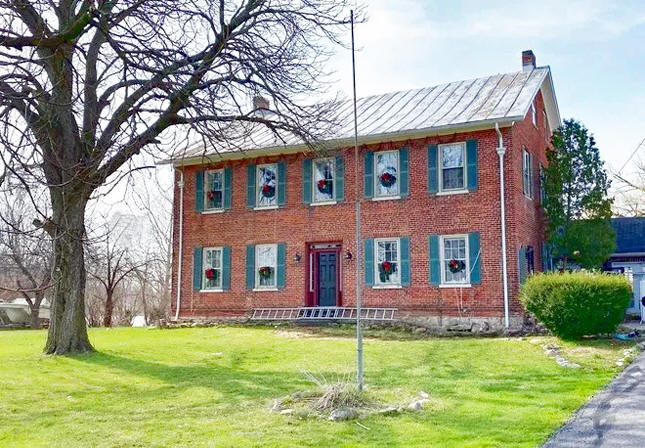
This
historic site is about 1.5 miles west of
"downtown" Grape on North Custer Road.
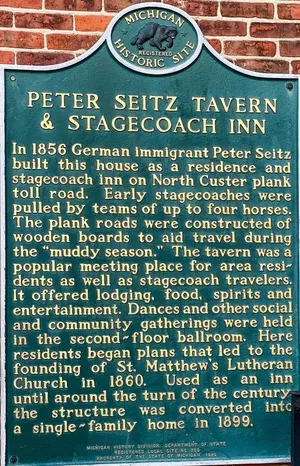
It was constructed in 1856 as the home of German
immigrant, Peter Seitz, who used it both as his home
and as a place for stage coaches to stop on their
trip between Monroe and Dundee. At that time, what
is now North Custer Road was an unpaved highway
which was covered with wooden planks. A few miles
from here as it turns north toward Milan, it becomes
Plank Road.
 In
1860, a local group of German immigrants met here to
make plans for the founding of
St Matthew Lutheran Church.
The first recorded date in the history of the St Matthew
congregation was June 3, 1860 when thirty Lutherans met in the
Bridge School on that Sunday, and Pastor F.A. Herzberger of Monroe,
Michigan, preached to them. At their request he came every three
weeks, and continued preaching. In
1860, a local group of German immigrants met here to
make plans for the founding of
St Matthew Lutheran Church.
The first recorded date in the history of the St Matthew
congregation was June 3, 1860 when thirty Lutherans met in the
Bridge School on that Sunday, and Pastor F.A. Herzberger of Monroe,
Michigan, preached to them. At their request he came every three
weeks, and continued preaching.
 A church constitution was adopted on the 21st of October, 1860, and
on November 12, 1860, at the home of Peter Seitz, the congregation
was organized. This later became the home of Mr. and Mrs. William Cominess,
8941 North Custer Road, who were also members of the congregation. A church constitution was adopted on the 21st of October, 1860, and
on November 12, 1860, at the home of Peter Seitz, the congregation
was organized. This later became the home of Mr. and Mrs. William Cominess,
8941 North Custer Road, who were also members of the congregation.
This meeting lasted from 9 a.m. until noon and twelve men were
present, besides Pastor Herzberger. These were the original members,
the fact being recorded twice in the church books. They were:
Friedrich Rath, Carl Rath, John Strass, Henry Burwitz, Carl Burwitz,
Frederick Rehberg, Ludwig Schulz, John Schulz, Joachim Baas, Adolph
Meier, John Goetz and Peter Seitz. These men and their wives had all
been born, baptized and confirmed in Germany, and most of them had
been in America less than five years. Peter Seitz was the oldest of
the company.
 Adolph
Meier was then the owner of
8861 Dixon Road
which would be purchased by
William Carl Heiden in 1909. This meeting
occurred 13 years before the arrival of
August and Rika Heiden into Monroe County. Adolph
Meier was then the owner of
8861 Dixon Road
which would be purchased by
William Carl Heiden in 1909. This meeting
occurred 13 years before the arrival of
August and Rika Heiden into Monroe County. |
|

By the time I was
around in the 1950s and 60s, it was the home of
William "Bill" Cominess who was a close friend
of my grandfather,
William Carl Heiden. They were the same age
and were probably life-long friends.
 Behind this house
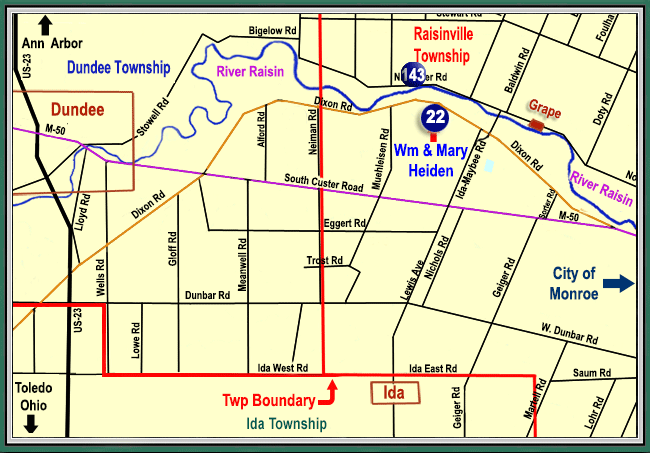
is the River Raisin. Directly across to the
south is part of the farm owned by Wm Carl at
8861 Dixon Road.
When the river was frozen in the winter, they
could simply walk across the ice to play
cribbage (card game) together. Behind this house
is the River Raisin. Directly across to the
south is part of the farm owned by Wm Carl at
8861 Dixon Road.
When the river was frozen in the winter, they
could simply walk across the ice to play
cribbage (card game) together.
In the early
1960s, I would mow Mr. Cominess' lawn. Often I
would drive a tractor or ride my bike across the
bridge near
Bridge School to get here although at the
time, I was living at
8864 Dixon Road,
also directly across the river.
It was a large
yard and took over two hours to mow for which I
received $3.00. Believe it or not, that was good
money back then. |








 The
river was named "Riviere aux Raisin" by the French-Canadian people
that first settled in Monroe County. They called it the River Raisin
because of the wild grapes growing along its banks. This led to the
naming of
The
river was named "Riviere aux Raisin" by the French-Canadian people
that first settled in Monroe County. They called it the River Raisin
because of the wild grapes growing along its banks. This led to the
naming of